Pocket Ninja Journal
Word Games to Learn a Language: What Each Kind Teaches
· 7 min read
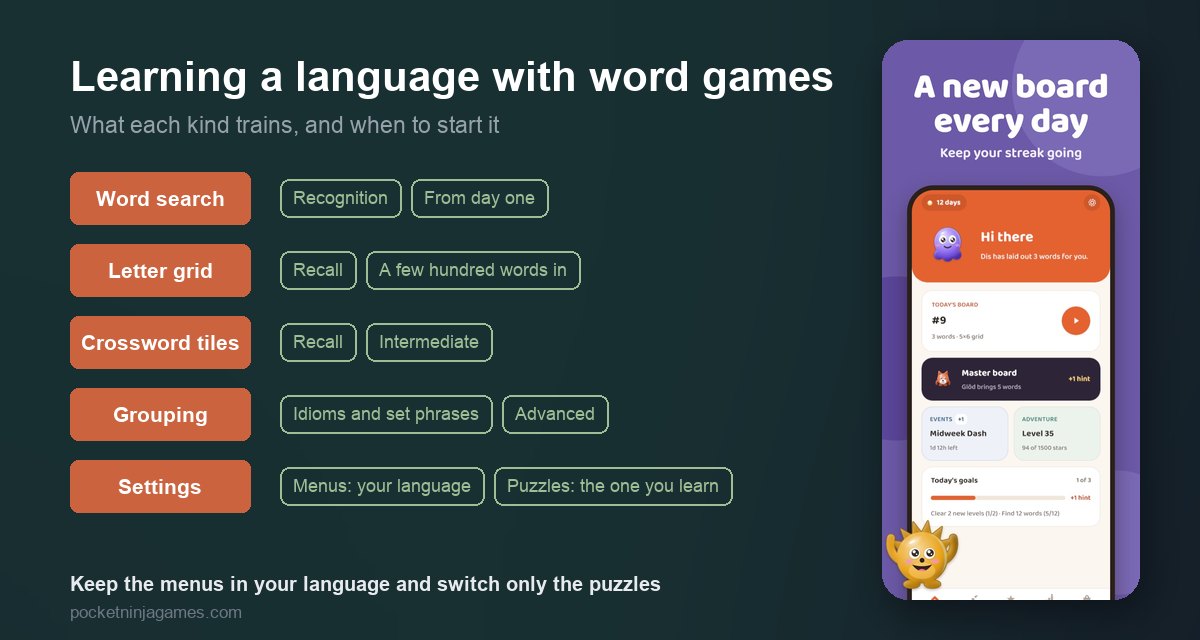
Short answer: word games are good at one part of learning a language — recognising and spelling the words you meet — and no help with grammar, listening or speaking. Choose the kind by your level: a word search from the first week, a letter grid once you can spell a few hundred words, a grouping puzzle last, because it runs on idioms. And keep the menus in your own language: both of our games let you switch only the puzzles.
What a word game can and cannot do for a learner
Knowing a word comes in two strengths. You can recognise it when you see it, or you can recall it — pull it out of memory when you need it. Recall is the one you need to write or speak, and having to fetch a word is also what makes it stick. Word games differ on exactly this point, which is why the kind you pick matters more than the brand.
What none of them does is teach grammar, pronunciation, listening or conversation. They are a good ten minutes a day next to a course, an app or a conversation partner, and a poor replacement for any of them.
Which kind trains what
| Kind of game | What you practise | Recognition or recall | Good from |
|---|---|---|---|
| Word search | The spelling of words you are given | Recognition | Day one |
| Letter grid or anagram | Pulling words out of your own memory | Recall | A few hundred words in |
| Crossword-style tiles | Building words that fit a board | Recall | Intermediate |
| Guess-the-word | Spelling patterns and common letters | Recall | Intermediate |
| Grouping puzzle | Meanings, double meanings and set phrases | Both, plus culture | Advanced |
The names and rules of each kind are in our guide to the types of word games. For a learner, the column that matters is the third one: start on the left of it and move right as your vocabulary grows.
Start with a word search, and start on a Monday
A classic word search hands you the list, so it can never ask for a word you have not learned yet. What it trains instead is the shape of the language: which letters travel together and how words begin and end. A learner of German starts to see sch and -ung everywhere, a learner of Spanish ll, rr and ñ, a learner of Dutch ij. That is reading practice, and it is real.
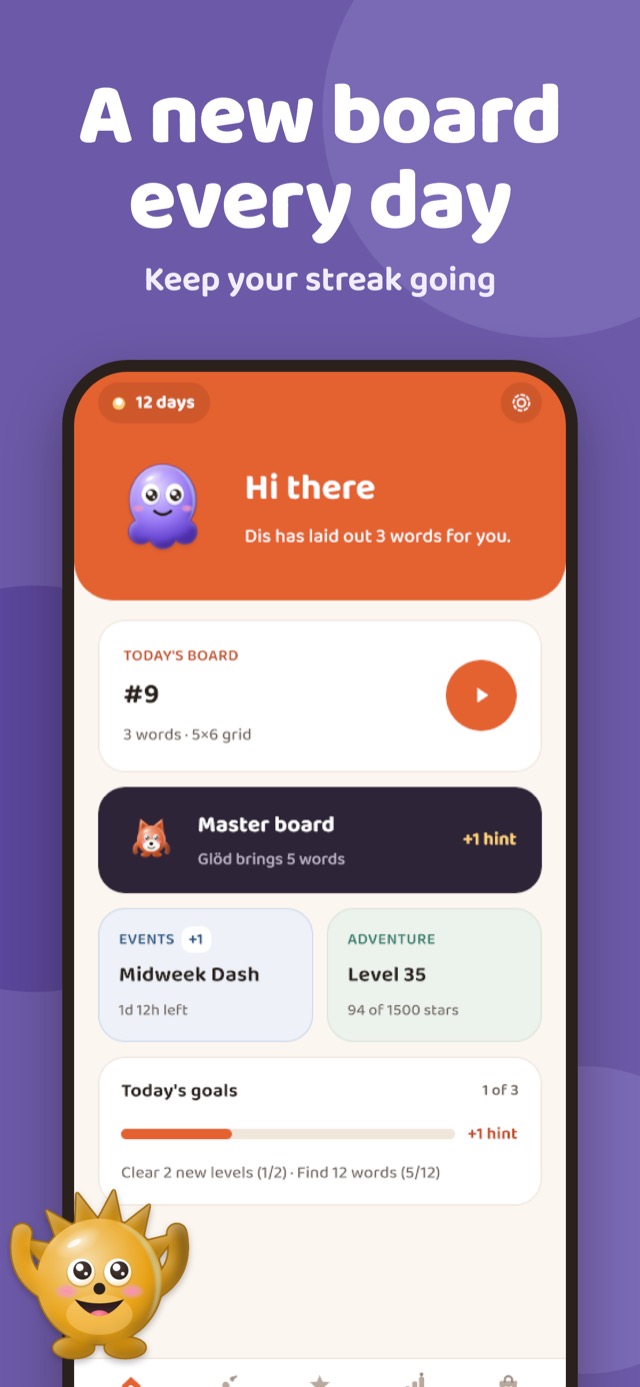
The other thing to get right is how common the words are. Inkwell’s daily board is built from the most common words in the language, and how far down that list it may reach grows through the week:
| Board | Drawn from the most common… |
|---|---|
| Monday | 1,500 words |
| Wednesday | 2,000 words |
| Friday | 2,500 words |
| Sunday | 3,000 words |
| Master board | 8,000 words |
Each day reaches 250 words further than the day before. So the week itself is a level ramp: early in the week suits a beginner, the weekend an intermediate learner, and the Master board someone who reads the language comfortably. Why the week has that shape is in how a daily board is built.
Then a letter grid, for recall
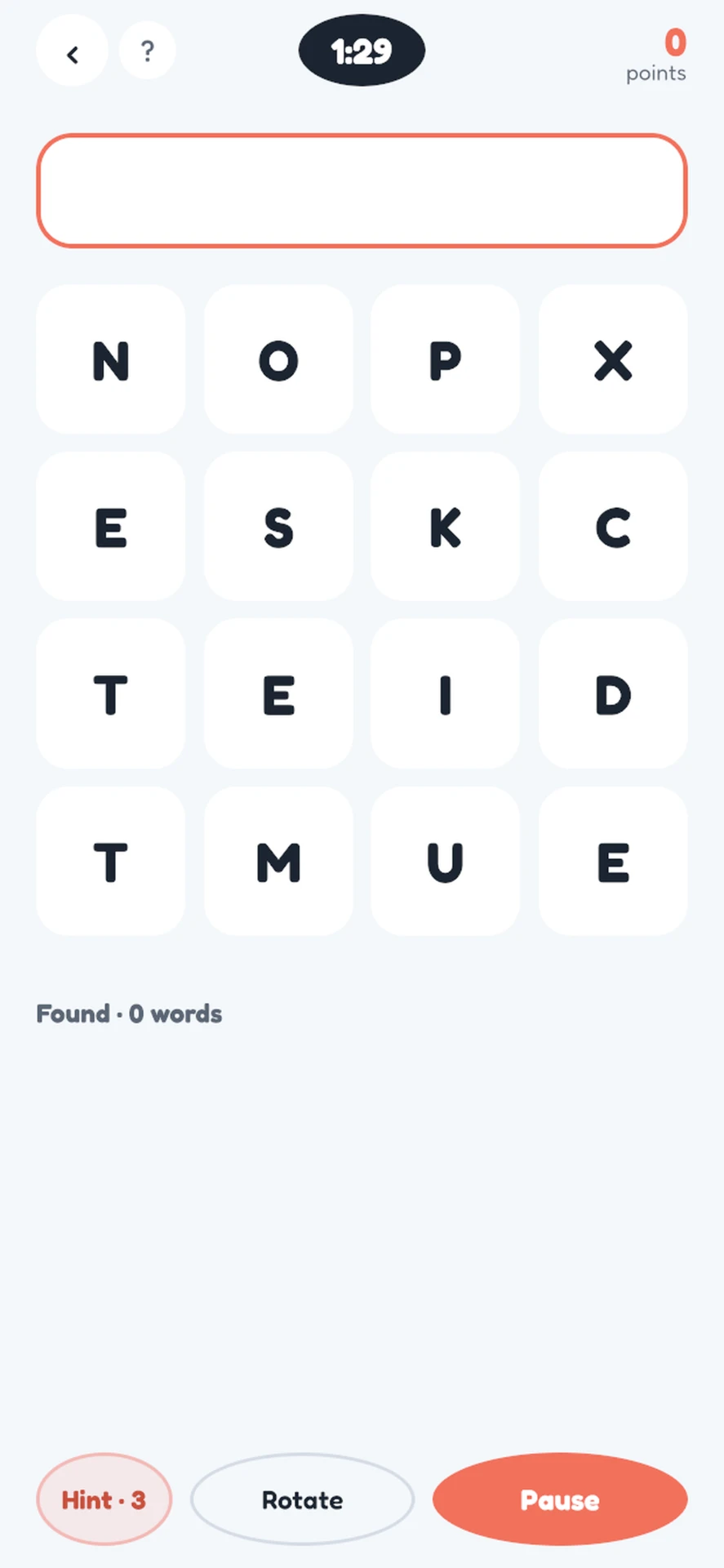
A letter grid gives you no list. Sixteen letters, and every word has to come out of your own head — exactly the recall practice a word search cannot give. Wordfly’s Letter Grid accepts any word of three letters or more, so a beginner’s short words count, and it runs for 90 seconds with a pause button. If the clock is too much, the pause is there to use: nobody is checking.
One habit makes a round worth more than its score: when the game accepts a word you were only half sure of, write it down. It is a real word — the list just said so — and looking it up afterwards turns a lucky guess into one you know.
Grouping puzzles come last
A grouping puzzle — sixteen words, four groups of four — looks like the easiest kind and is the hardest for a learner. Its categories lean on things native speakers absorb as children: idioms, fixed phrases, words with two meanings. In Wordfly’s English pack about one category in seven is fill-in-the-blank, like ___ball, and knowing every word on the board does not help if you have never heard the phrase. How these puzzles are built explains why one word always seems to fit two groups.
That is also why they are worth reaching for. Once you can manage them, each solved puzzle teaches a set phrase that no word list would. Wordfly has Groups puzzles in every language it offers, and the fill-in-the-blank categories follow each language’s own phrases: the English ___ball is ___boll in Swedish and Balle de ___ in French.
How to switch only the puzzle language
Both of our games keep two language settings apart. Language decides the menus and messages. The second one decides the puzzles: in Wordfly it is called Puzzle language and covers the words, the daily puzzles and the letters; in Inkwell it is Word language, the words on every board. Keep the menus in the language you read best and set only the puzzles to the one you are learning, so you never have to decode a button.
There are 9 options: American, British and Australian English, Swedish, Danish, Dutch, German, French and Spanish. The three Englishes are separate lists, and the difference is useful. The British and Australian lists leave out American spellings like COLOR, FAVORITE and THEATER, while the American list leaves out FAVOURITE but accepts many British forms as well. If you are being taught British English, choose British, and the game will never reward a spelling your teacher would mark wrong.
A ten-minute routine that helps
- One board a day in the language you are learning, at the same time every day. Short and regular beats long and rare; we have written about why a short habit lasts.
- Say every word you find out loud. The game cannot teach pronunciation, but it can give you something to pronounce.
- Write down three words you were not sure of, look them up afterwards, and use one of them in a sentence that day.
- Once a week, play a round with no list — a letter grid — to find out which words you can recall rather than only recognise.
- Keep the course. The game is the warm-up, not the lesson.
Where our games fall short for learners
Wordfly does not show what words mean. Inkwell has one small help: tap a word you have found and it opens on Wiktionary, in the edition for that word’s language — an explanation in the language you are learning, not a translation into yours. Keep a dictionary of your own next to you all the same. The word lists were built to fill puzzle boards, not to teach, so they include rare words and inflected forms alongside the everyday ones. In French and Spanish they are written without accents — ELEVE for élève, CANCION for canción — though Spanish keeps its Ñ, so check the accent when you look a word up. And Wordfly’s Letter Grid is a race against the clock, which is not everybody’s idea of study.
What they do offer a learner is a native word list for each of the nine options, a daily board that starts each week with the most common words, and menus that can stay in your own language. Inkwell is the calmer of the two — no clock, no score, every board can be finished, and a hint shows where a word starts. If you want the clock and the grouping puzzles as well, the comparison of our two games sets them side by side.
Inkwell Word Puzzle
A calm word search in 9 language options, with the menus and the words set separately. One board a day and 600 levels behind it. Free to download with ads, no account, plays offline.

Frequently asked
Can you learn a language with word games?
Part of one. Word games are good at the written vocabulary: recognising words, spelling them and, in some kinds, recalling them from memory. They teach no grammar, pronunciation, listening or conversation. Use them as ten minutes a day next to a course, an app or a conversation partner, not instead of one.
Which word game is best for a beginner in a new language?
A word search. A classic one gives you the list of words to find, so it never asks for a word you have not learned yet, and finding them trains your eye for how the language is spelled. Inkwell hides its words instead and shows only how long each one is, but Monday's board draws only on the 1,500 most common words in the language and each day reaches just 250 further, which suits a beginner.
Can I play Wordfly or Inkwell in a language other than my phone's?
Yes. Both games keep the language of the menus apart from the language of the puzzles. In Wordfly the second setting is called Puzzle language, in Inkwell Word language. Keep the menus in your own language and set only the puzzles to the one you are learning.
Do the games use British or American spelling?
You choose. There are three English word lists: American, British and Australian. The British and Australian lists leave out American spellings such as COLOR and THEATER, so if you are learning British English, pick British and the game will never accept an American form.
Are grouping puzzles good for language learners?
For advanced learners, yes, and they are the hardest kind to start with. The categories lean on idioms, fixed phrases and double meanings that native speakers pick up as children. Once you can manage them, every solved puzzle teaches you a phrase that no word list would.
More reading: why a word game is not the same game in every language · how a word search works · letter grid strategy.