Pocket Ninja Journal
Types of Word Games and What They're Called
· 6 min read
Short answer: almost every word game belongs to one of eight families — word search, letter-grid hunts, anagrams, crossword-style tiles, guess-the-word, grouping, ladders and fill-ins. Each asks for a different skill, and each goes by several names, some of which change between British and American English.
Our guide to picking a free word game for iPhone has a quick five-type overview. This article goes further: what each family is called, how it actually plays, what it rewards, and where our own game, Wordfly, fits.
The families at a glance
| Family | What people call it | Wordfly mode |
|---|---|---|
| Word search | Wordsearch (UK), word search or word find (US), find-a-word | Word Drop (a cousin) |
| Letter-grid hunt | Word grid, word hunt, Boggle-style game | Letter Grid |
| Anagram game | Anagrams, word wheel, jumble, word scramble | — |
| Crossword-style tiles | Tile game, word builder, Scrabble-style game | Tile Board |
| Guess the word | Wordle-style game, five-letter word game, hangman | — |
| Word grouping | Connections-style game, connecting wall, categories | Groups |
| Word ladder | Word ladder, doublets, word golf, word chain | — |
| Fill-in and coded grids | Fill-in or fill-it-in (US), kriss kross (UK), codeword (UK) | — |
1. Word search
Also called: wordsearch (common in British English), word search or word find (American), find-a-word, word seek.
A puzzle-book staple: a block of letters and a list of words hidden in it, usually in straight lines — across, down, diagonal, sometimes backwards. You know what you are looking for; the game is in finding where. It rewards pattern-scanning more than vocabulary, which is why it suits people who want to relax rather than be tested.
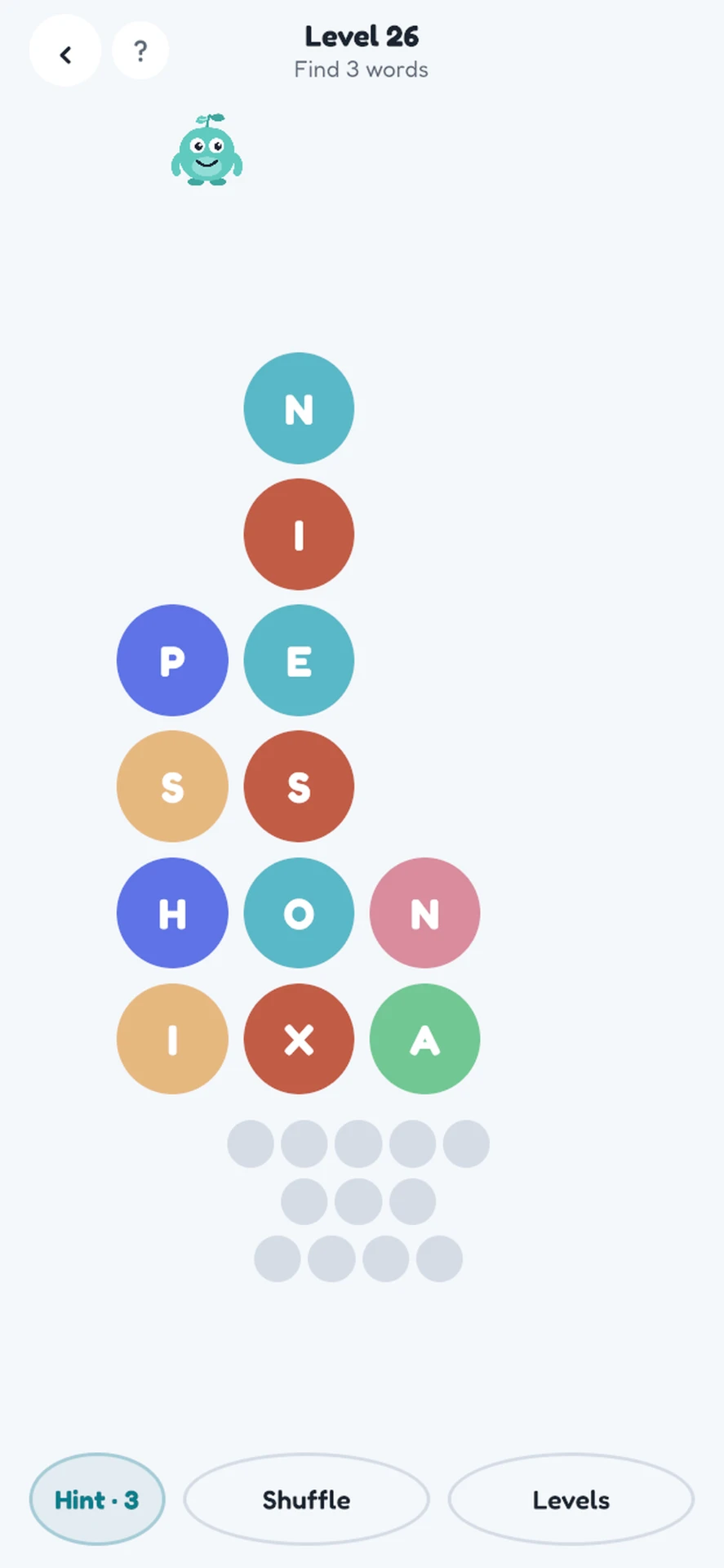
In Wordfly: Word Drop is a close cousin. Each of its 400 levels gives you a list of words to find in a stack of letter bubbles, so you know the targets, but the letters do not sit in neat rows. Our next game, Inkwell, is a calm word search of its own and is coming soon.
2. Letter-grid hunts
Also called: word grid, word hunt, letter grid, or a Boggle-style game, after the board game with a shaken tray of letter dice.
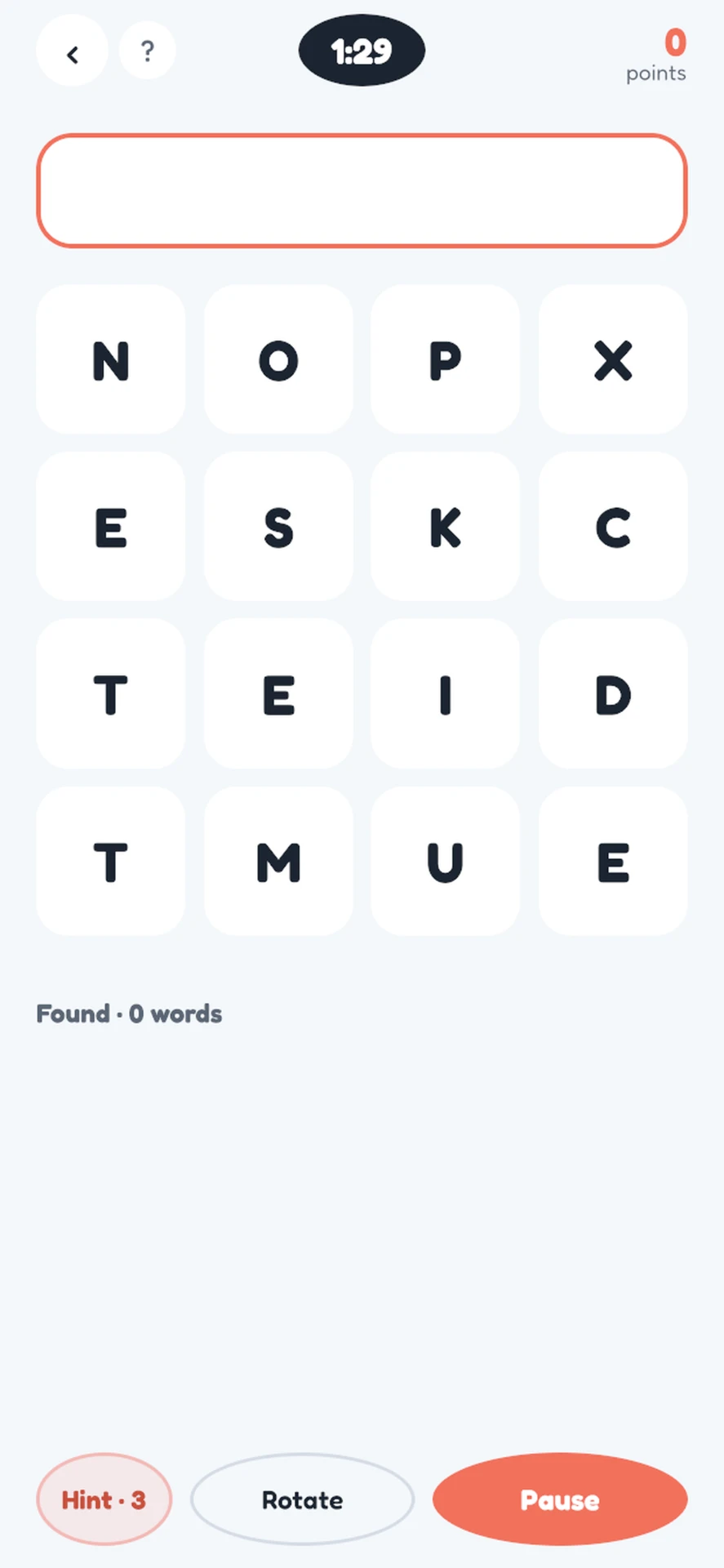
Here there is no list. You get a small grid — often 4×4 — and find any word you can by joining letters that touch, usually including diagonals, without using a square twice. A clock is common. It rewards vocabulary and speed, and above all the habit of extending a short word into a long one.
In Wordfly: Letter Grid — a 4×4 board, 90 seconds, words of three letters or more. Our letter grid strategy guide explains how scoring works and how to find more words.
3. Anagram games
Also called: anagrams, word wheel (a newspaper favourite in Britain), jumble or word scramble (common American names), word connect.
A fixed set of letters, and your job is to rearrange them: into one target word, or into as many words as possible. Word wheels put one letter in the middle that every word must use. The difference from a letter grid is that position does not matter — any letter can follow any other — so it is purely about what words the letters can make.
In Wordfly: there is no anagram mode. If you enjoy these, the letter grid is the nearest relative.
4. Crossword-style tile games
Also called: tile game, word builder, crossword builder, or a Scrabble-style game.
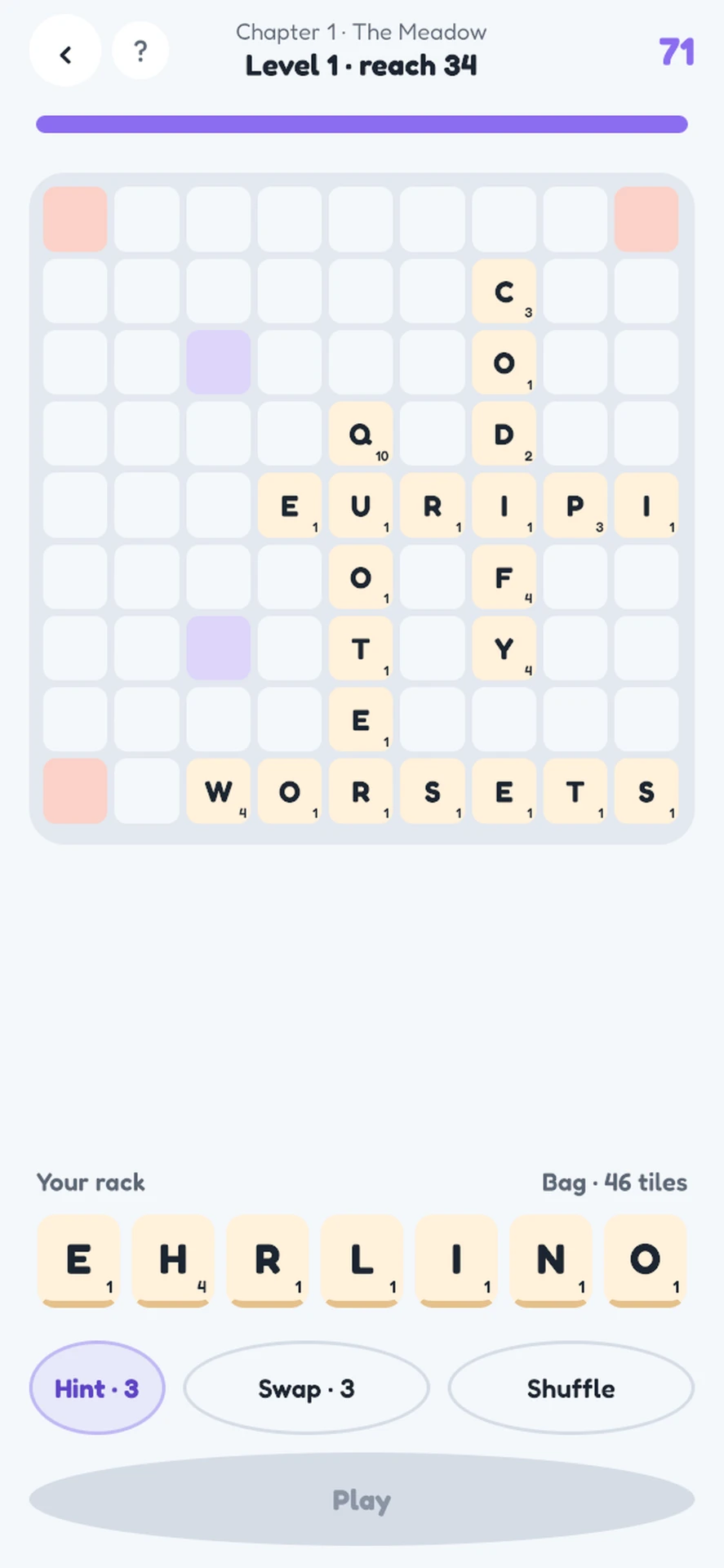
You place letter tiles on a board so that words cross, the way they do in a crossword, and letter values and board squares decide the score. It is the most spatial family: where a word goes matters as much as what it is, which is why these games feel closest to a board game.
In Wordfly: Tile Board, the campaign — 400 levels in 40 chapters. Each level has a target score to reach in a limited number of turns, up to three stars, and three swaps per level. The mode-by-mode guide walks through a level.
5. Guess the word
Also called: Wordle-style game, five-letter word game, word guessing game; hangman is the classic pen-and-paper ancestor.
A hidden word and a limited number of guesses, with feedback after each one about which letters are right. It is deduction more than vocabulary: a good guess is one that rules out the most. Rounds are short, which makes this the natural format for a daily puzzle.
In Wordfly: none. For where to play this family, see our map of daily word games.
6. Word grouping
Also called: Connections-style game, grouping puzzle, categories game. British viewers will know the idea as the connecting wall from the quiz show Only Connect.
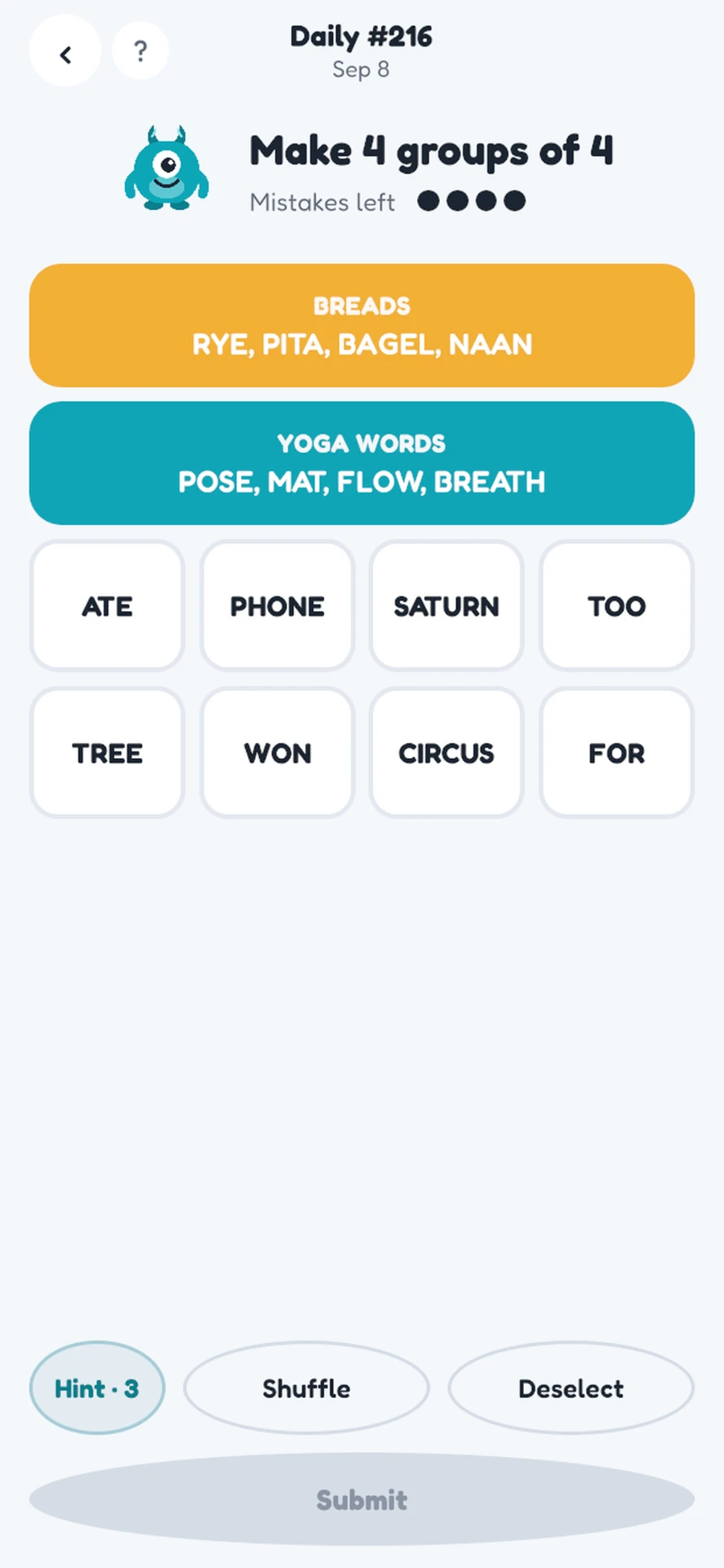
A set of words hides several groups that share something — a meaning, a sound, a missing word. The skill is lateral thinking: the obvious group is often a trap, because one of its words belongs somewhere else.
In Wordfly: Groups — 16 words, 4 groups of 4, up to 4 mistakes — including a daily Groups puzzle drawn from a pack bundled with the app, which repeats. Our Groups strategy guide covers how to spot the trap.
7. Word ladders
Also called: word ladder, doublets (Lewis Carroll's name for it in the 1870s), word golf, word chain.
Turn one word into another by changing one letter at a time, with a real word at every rung: COLD, CORD, CARD, WARD, WARM. It rewards a feel for how words sit next to each other, and it works equally well on paper and on a phone.
In Wordfly: none.
8. Fill-ins and coded grids
Also called: fill-in or fill-it-in in American puzzle books, kriss kross in British ones; the coded version, where each number stands for a letter, is a codeword in Britain.
A crossword grid with no clues. In a fill-in you get a list of words sorted by length and have to fit them in; in a codeword you get a few letters and crack the rest. Both are about logic and elimination more than knowledge, which is why they appeal to people who find clued crosswords frustrating.
In Wordfly: none.
Which family suits you?
- You want to switch off: word search.
- You want to be quick: a letter-grid hunt.
- You like deduction: guess the word, or a codeword.
- You like a trick: word grouping.
- You like planning: crossword-style tiles.
Whatever the family, if you often play without a signal, check the game keeps its puzzles on the phone. Our note on offline word games shows how to test that before a flight.
Wordfly: Daily Word Puzzles
Four families in one app: Groups, Letter Grid, Tile Board and Word Drop. Free on the App Store, no account, plays offline.

Frequently asked
What are the main types of word games?
Word search, letter-grid hunts, anagram games, crossword-style tile games, guess-the-word games, word grouping, word ladders and fill-in grids. Most word games on a phone are one of these, or a mix of two.
What is a game like Boggle called?
Usually a word grid or word hunt game. You trace words through touching letters on a small square grid, often against a clock. Boggle is a brand name, so apps tend to describe themselves as word grid, letter grid or word hunt games instead.
What is the difference between a word search and a letter grid game?
A word search gives you a list of words to find in straight lines. A letter-grid game gives you no list: you find any word you can by joining neighbouring letters, often bending in any direction. One is a checklist, the other a treasure hunt.
Is it wordsearch or word search?
Both are correct. Wordsearch as one word is common in British puzzle books, while American English mostly writes word search, and word find is also used there.
What is a word ladder?
A puzzle where you change one word into another one letter at a time, making a real word at every step — for example turning COLD into WARM. Lewis Carroll popularised it in the 1870s under the name doublets.
More reading: daily word games beyond Wordle · all four Wordfly modes explained · how to pick a free word game.