Pocket Ninja Journal
Letter Grid Strategy: Score More in 90 Seconds
· 6 min read
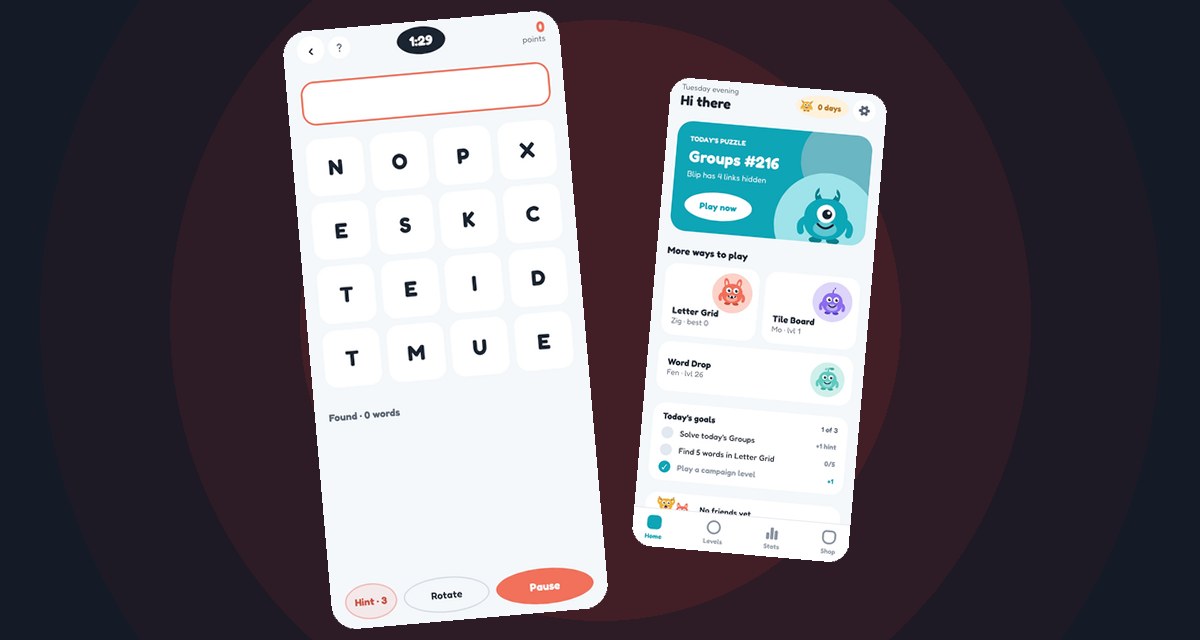
Short answer: stop hunting for new words and start extending the ones you have. Scoring multiplies by length, so one eight-letter word can outscore the ten best three-letter words on the same board — and it usually starts as a word you already found.
Scoring is why long words win
A 4×4 grid with a 90-second clock looks like a speed game, and most people play it that way: sweep the board, submit everything short, repeat. But in Wordfly's Letter Grid the points for a word are the sum of its letters multiplied by a factor that grows with length:
| Letters | Multiplier | What that means |
|---|---|---|
| 3 | ×1 | The floor. Fine for warming up, not for a score. |
| 4 | ×2 | One extra letter already doubles the word. |
| 5 | ×3 | Where most good boards live. |
| 6 | ×4 | Worth hunting for deliberately. |
| 7 | ×5 | Usually a five-letter word with an ending on it. |
| 8+ | ×6 | One of these can carry a whole round. |
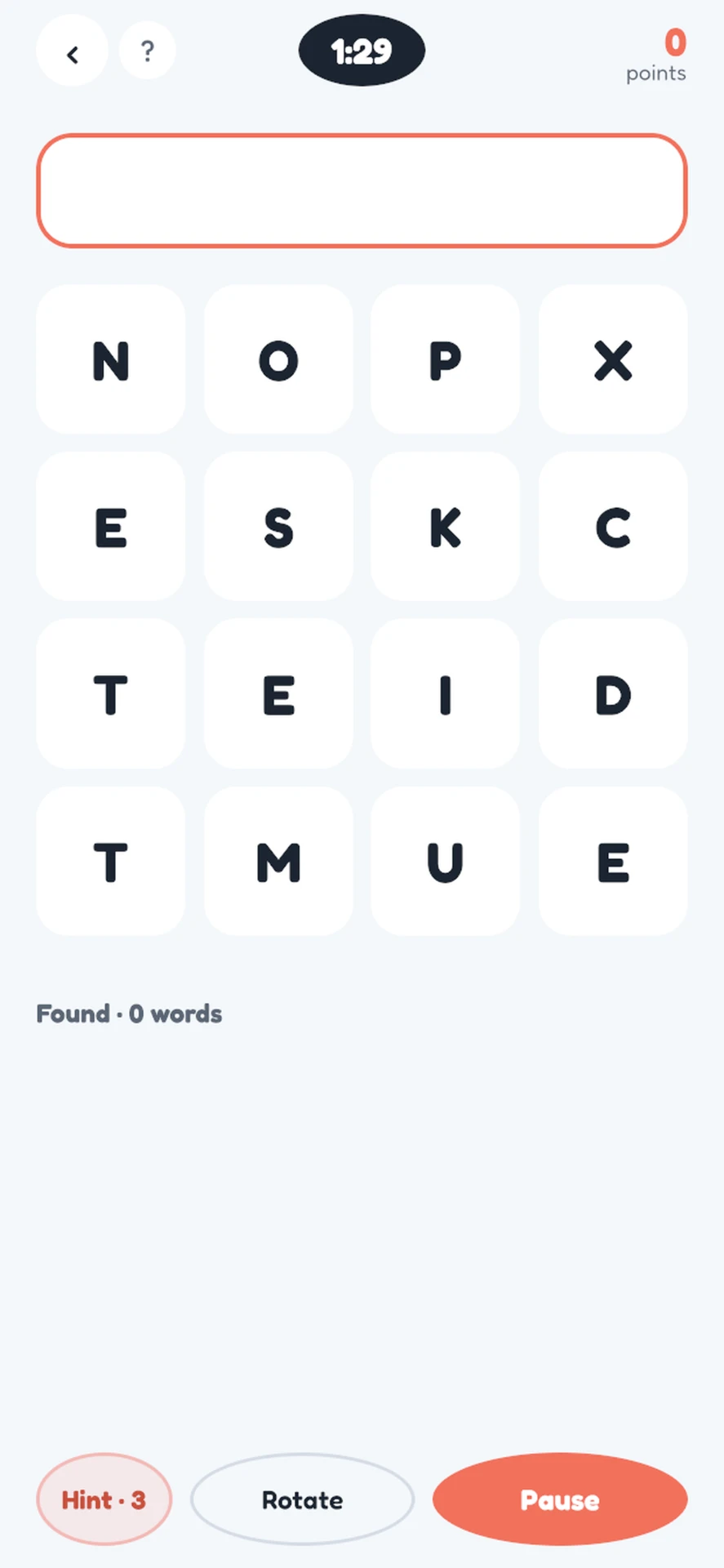
The practical consequence: the last letter you add is the most valuable one. On the board in the picture above, POKE is worth 20 points. POKES — one more letter, one more tap — is worth 33.
The rules that should change your tactics
- Three letters minimum. Two-letter words are not accepted, however tempting.
- Letters must touch, diagonals included. Every square in the middle has eight neighbours; a corner has three.
- No square twice in the same word. If a word needs two of a letter, the board needs two of that letter.
- Drag back to undo. Sliding onto the previous letter removes the last one instead of ending the word, so a wrong turn costs nothing.
- Qu is one square. In English, the Q square plays as Qu, so QUIT takes three taps and still counts as four letters.
- Rotate is free. It turns the grid 90 degrees without changing a single neighbour — same board, new view.
Find a stem, then grow it
Finding a word is mostly finding a path. Once you have one, the expensive work is done, so the next move should be to make that path longer rather than to start somewhere else:
- Add the plural. If an S sits next to the last letter, almost every noun on the board doubles as a second, better word.
- Add an ending. -ED, -ER, -ING and -EST turn a four-letter word into a six- or seven-letter one. The word list includes inflected forms, so they count.
- Go one letter further before submitting. SET is three points. STEM, on the same board, is twelve.
- Try the front, too. A spare S or RE in front of a word you already traced is the cheapest long word there is.
Read the board before the clock starts mattering
Boards are not random letter soup. Every board is built from dice and then checked: it always has between five and eight vowels, never more than three of the same letter, and the game keeps the richest board it can build rather than the first one. So there is always material — if a board looks barren, it is the reading that needs work, not the board.
The grid in the picture above has 138 findable words. Its best is DISKETTE, which uses eight of the sixteen squares and scores 78 — more than the ten best three-letter words on the same board put together, which come to 72.
Three habits make boards readable:
- Start in the middle. The four central squares have the most neighbours, so words that pass through them have the most ways to continue.
- Say the letters as pairs. ST, TR, CH, EE — your eye finds pairs faster than single letters, and pairs are where words begin.
- Sweep for one ending at a time. Look only for -ER words for ten seconds, then only -ING. A single-minded search beats a general one.
What a hint is actually worth
A hint reveals a word that is on the board and shows you its path — but it offers the shortest word you have not been shown yet, so it is worth points, not a rescue. Spend hints when you are stuck on reading the board rather than as a scoring tool. Free players get two hints a day; Wordfly Plus, the optional subscription, gives five a day, and hint packs are available as a one-time purchase.
The last fifteen seconds
When the clock is nearly out, stop looking for new words. Go back to the longest word you found and check its neighbours once more for one extra letter. A single ×6 word submitted at 0:03 is worth more than three rushed three-letter words — and unlike them, it is still worth finding even if you run out of time mid-trace, because nothing is lost by trying.
Wordfly: Daily Word Puzzles
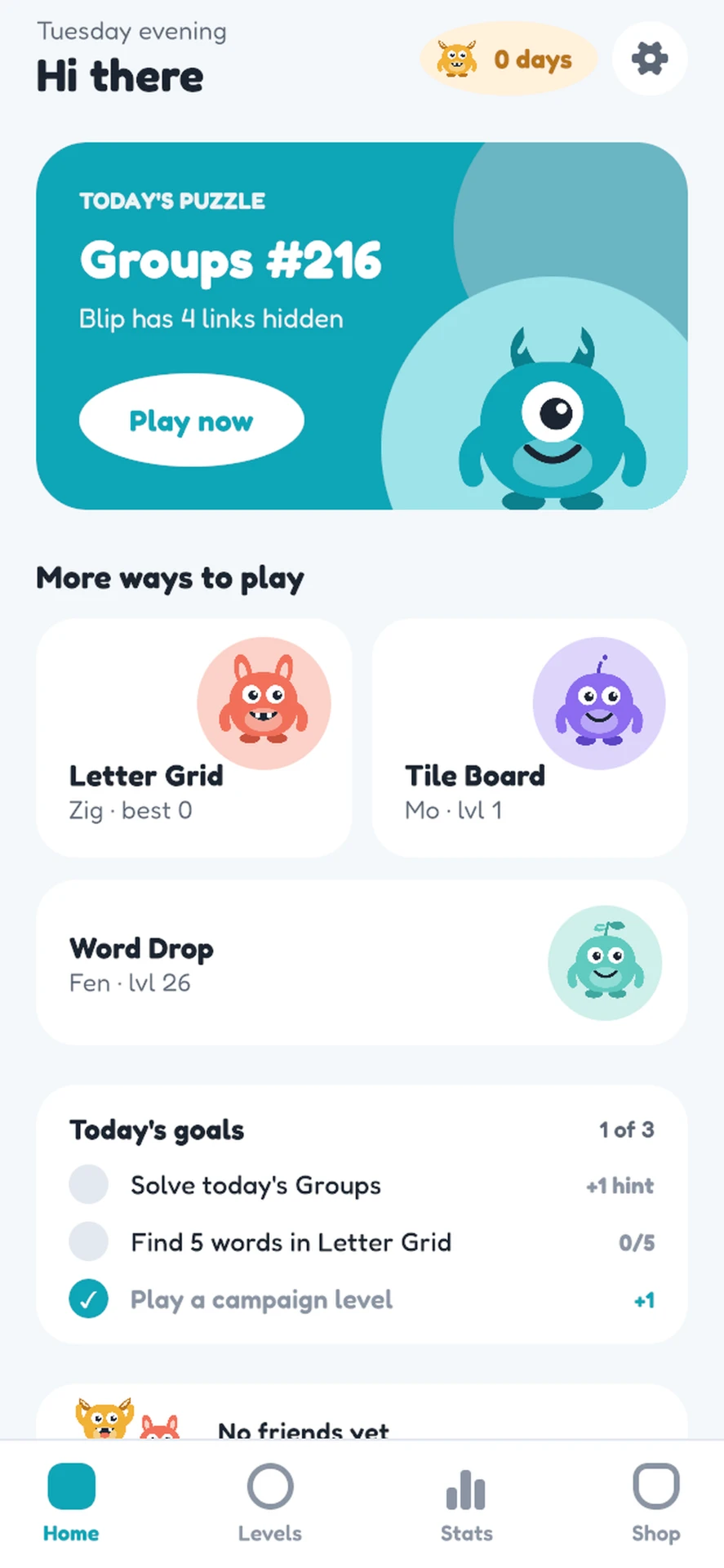
Letter Grid, a daily Groups puzzle and two more word games. Free on the App Store, no account, plays offline.

Frequently asked
How do you score points in a letter grid game?
In Wordfly's Letter Grid every letter has a point value and the total is multiplied by the word's length: ×1 for three letters, ×2 for four, ×3 for five, ×4 for six, ×5 for seven and ×6 for eight or more. That is why one long word is worth more than several short ones — POKE scores 20 on the board in this article, POKES 33.
What is the fastest way to find more words in a 4×4 grid?
Find a short word, then extend it instead of starting over. Add an S, an -ED or an -ING, or trace one letter further before you submit. Each extra letter raises the multiplier, and you have already done the hard part: finding a path that works.
Do plurals and verb endings count?
Yes. The word list contains inflected forms, so plurals, past tenses and other endings are valid words if you can trace them on the board. Hyphens, capitals and accents are not part of the grid.
Does rotating the board give you new words?
No. Rotating turns the grid 90 degrees so you see it from a new angle; the letters keep the same neighbours, so exactly the same words are there. It is free and unlimited, and it helps because a word you cannot see sideways often jumps out once it reads left to right.
Can you play Letter Grid offline?
Yes. Letter Grid, the daily Groups puzzle, Tile Board and Word Drop all work without a connection, because the word list ships with the app. A connection is only needed for ads, purchases and restoring them, Game Center and iCloud sync.
More reading: strategies for the daily Groups puzzle · all four Wordfly modes explained · the game page.