Pocket Ninja Journal
Why One Word Always Fits Two Groups
· 7 min read
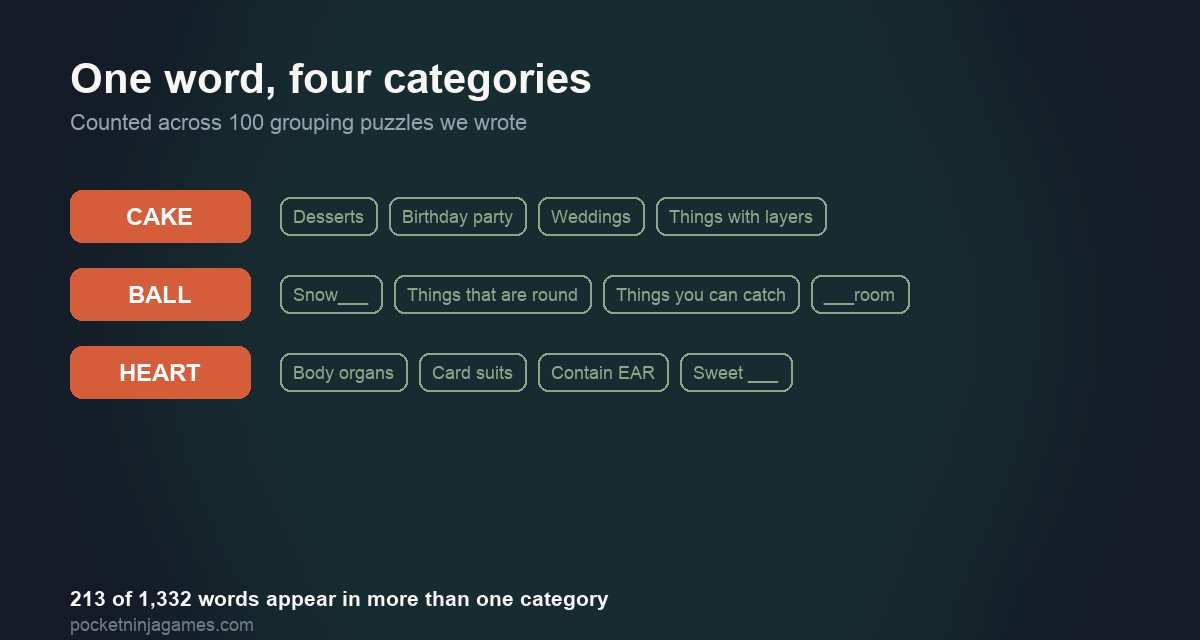
Short answer: the word that fits two groups was put there to fit two groups. The overlap is the puzzle. We wrote a hundred of these in English, and when you count them the trap is not an occasional flourish — it is most of the craft.
The shape of the thing
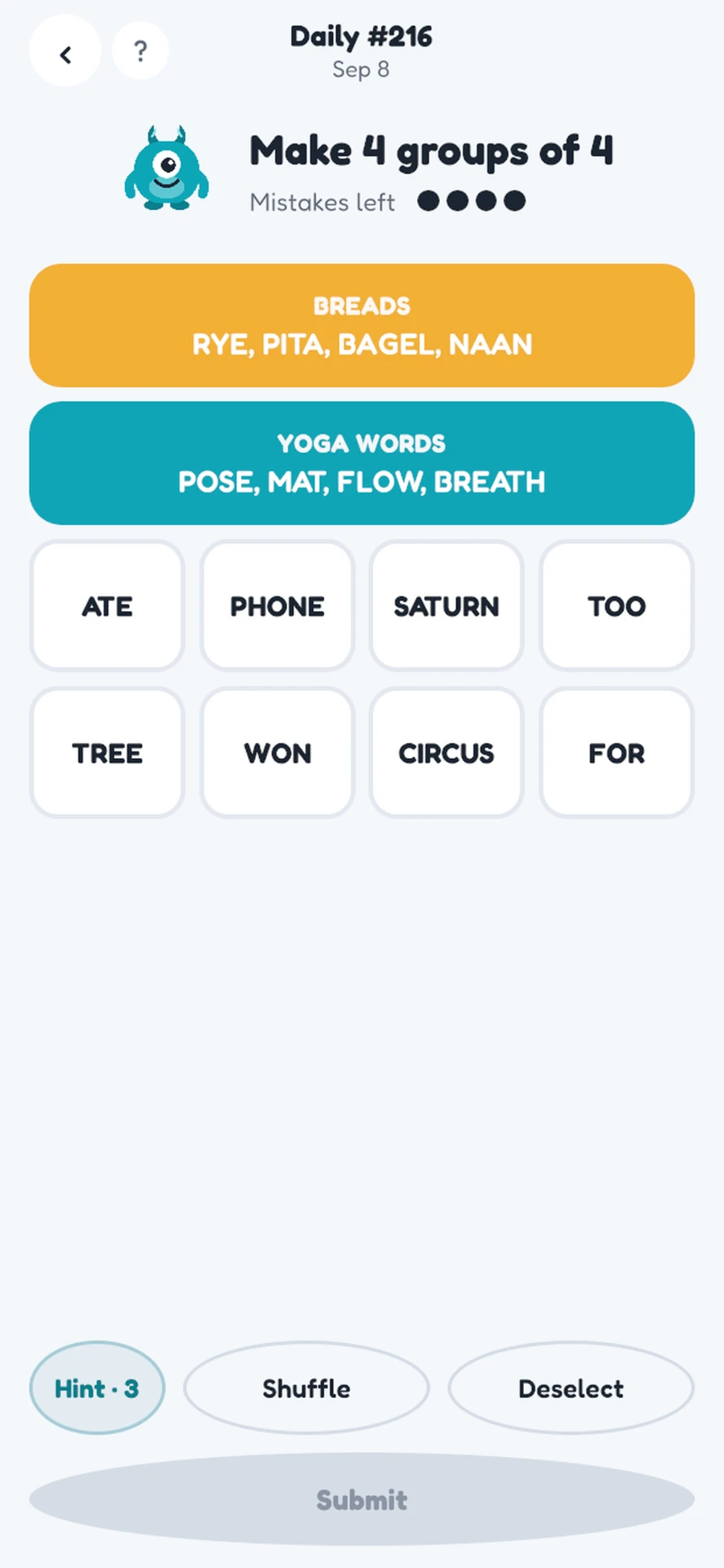
A grouping puzzle gives you sixteen words and asks for four groups of four. You usually get 4 wrong guesses before it ends. That is the whole rulebook, and it is why the format travels so well: there is nothing to learn before you start.
What the rules hide is that a good puzzle is not four categories placed side by side. It is four categories arranged to interfere with each other. Here is one of ours, with the answers, so the interference is visible:
| Category | Words |
|---|---|
| School subjects | SCIENCE, ART, HISTORY, MUSIC |
| Baby animals | CUB, KID, CALF, FOAL |
| Ballet words | PLIE, TUTU, BARRE, POINTE |
| Contain EAR | HEART, BEARD, LEARN, PEARL |
HEART is in the last group because of its letters, not its meaning — and it would sit perfectly happily in a group about the body, or about card suits. If you had seen a body category anywhere on that board, HEART would have gone there, and you would have spent a mistake finding out.
The overlap, counted
We make a word game with a grouping mode, so we have a hundred of these written out in English. Counting them turns a feeling into a number:
- 100 puzzles, 400 categories, 1,600 word slots.
- 1,332 distinct words — and 213 of them appear in more than one category across the pack.
- 12 per cent of the categories are fill-in-the-blank rather than meaning: ___ball, Sun___, ___print.
- Every puzzle has exactly one group at each of four difficulty levels. There is always one meant to be found first, and one meant to hold out.
The words that do the most work are the ones that belong everywhere:
| Word | Categories it has appeared in |
|---|---|
| CAKE | At a birthday party · Desserts · Things at a wedding · Things with layers |
| BALL | Snow___ · Things that are round · Things you can catch · ___room |
| BUTTER | Baking ingredients · Dairy · ___fly · ___nut |
| HEART | Body organs · Card suits · Contain EAR · Sweet ___ |
| CARD | Things in a wallet · Things with a face · Things you draw · Ways to pay |
None of these are clever words. CAKE, BALL, BUTTER, CARD — that is the point. A grouping puzzle is never difficult because of vocabulary. It is difficult because ordinary words have more than one life.
Three kinds of category, and one of them lies
- Meaning. Card games, body organs, baking ingredients. The honest kind: the four words share an idea.
- Fill-in-the-blank. ___ball, Sun___, ___print. Still fair, but the connection is a word you cannot see on the board.
- Letters. Contain EAR, Contain ONE. The four words share nothing but a string of letters, and the eye will keep looking for a meaning that was never there.
The third kind is rare — three of our four hundred categories — and disproportionately the reason a solve collapses. If three groups fall quickly and the last four words look like nonsense together, stop looking for an idea and start reading the letters.
What the construction tells you about solving
Knowing how these are built changes the order you work in. The usual advice is to start with the group you are surest of. That is only half of it:
- Find your surest group, then try to break it. Take each of its four words and ask whether any other visible category wants it. The word that answers yes is the trap, and the group you were about to submit is one word wrong.
- Solve from the leftovers. The four words with no obvious home are often a real category you have not recognised — frequently the letters kind.
- Spend the easy group last if you can. It will still be there. The hard group is the one that benefits from having twelve fewer words to hide among.
- Count the duplicates. If a word could be in three groups, the puzzle probably intends it for the one you thought of last.
More of that, in practical order, is in seven strategies for the daily grouping puzzle.
How ours get made, honestly
Every one of these puzzles was written by a person. A generator can fill a board, but it cannot invent the idea that ties four words together, and it certainly cannot judge whether a trap is fair or merely annoying — the difference between a puzzle you enjoy losing and one you resent.
The consequence is worth stating plainly: because they are written rather than generated, the daily puzzle in our game comes from a pack of 100 per language, and once you reach the end it starts again. A game whose daily puzzle is generated can be endless; one whose daily puzzle is written cannot. We would rather have the written ones. If you want the other trade, our word search builds a genuinely new board every day on the device, because a word search is the kind of puzzle a machine can make well.
Wordfly: Daily Word Puzzles
A daily grouping puzzle — sixteen words, four groups, 4 mistakes — plus three other word games. Free on the App Store, no account, plays offline.

Frequently asked
Why does one word seem to fit two groups?
Because it was chosen to. The overlap is the puzzle, not a flaw in it. In the hundred English puzzles we wrote, 213 of the 1,332 distinct words are used in more than one category across the pack — CAKE turns up under desserts, birthday parties, weddings and things with layers. A grouping puzzle where every word had exactly one home would be a sorting exercise, not a puzzle.
How do you solve a grouping puzzle?
Find the category you are surest of and resist submitting it. Check first whether any of its four words could belong to another group you can see, because the word that fits two places is usually the one placed to catch you. Submit the group you are sure about only when the other twelve words have nothing better to offer it.
What makes a grouping puzzle hard?
Not vocabulary. Every word in a well-made grouping puzzle is ordinary — the difficulty is in the connections, not the words. Hardness comes from categories that overlap, from wordplay categories that look like meaning categories, and from a deliberate ladder: in our packs every puzzle has one group at each of four difficulty levels, so there is always one group meant to be found first and one meant to resist.
Are grouping puzzles generated by a computer?
Ours are not, and most are not. A generator can place words on a board, but it cannot invent the idea that ties four of them together or judge whether a trap is fair. Every one of our hundred puzzles per language was written by a person. That is also why the daily puzzle comes from a pack that eventually repeats, rather than appearing out of nowhere each morning.
What does a category like 'Contain EAR' mean?
It is a wordplay category: the four words are connected by their letters rather than their meaning. HEART, BEARD, LEARN and PEARL have nothing in common except the letters E-A-R inside them. These are rarer than meaning categories — three of our four hundred — but they are disproportionately the ones that break a solve, because the eye keeps hunting for a shared idea that is not there.
More reading: seven strategies for the daily grouping puzzle · a map of the daily word games · every type of word game explained.