Pocket Ninja Journal
Why Monday's Puzzle Is Easier, and How a Daily Board Is Built
· 7 min read
Short answer: the week has a deliberate shape. Monday is a warm-up and the weekend is the test, in our game and in most others. Here is the exact curve, taken from our own code, and how a phone manages to build a brand new board every morning without asking a server for anything.
The week has a shape
Inkwell’s daily board is not one difficulty repeated seven times. Three things move through the week: how many words you have to find, how long they are, and — the one nobody talks about — how obscure they are allowed to be.
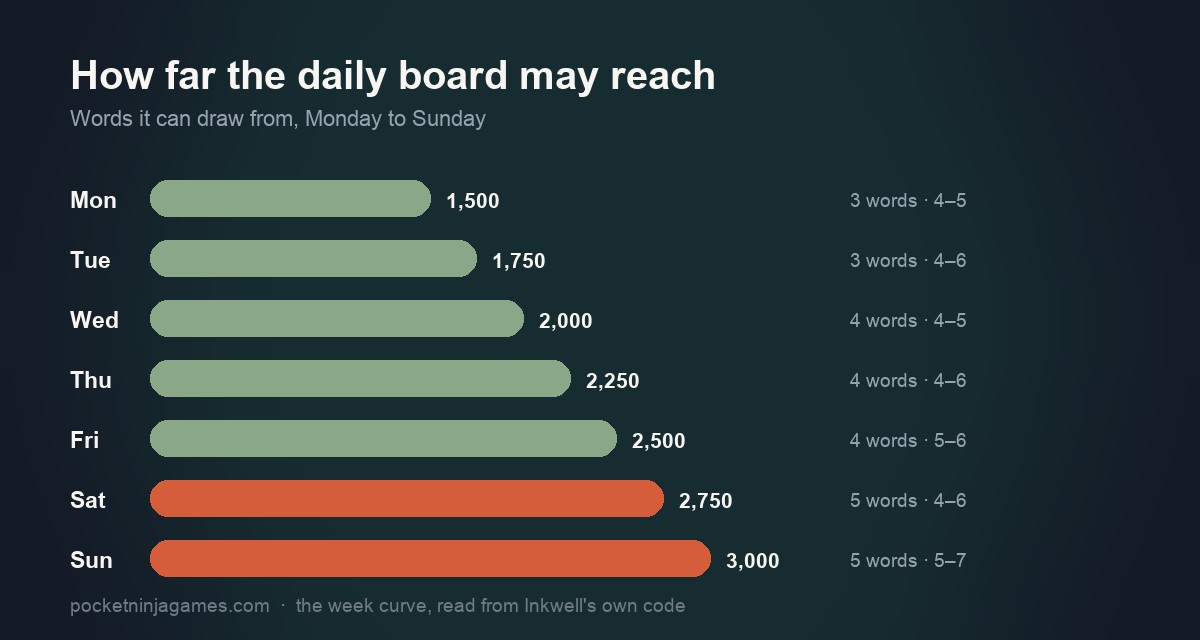
That last one is the interesting lever. The game keeps a list of words ordered by how common they are, and each day may only draw from the top of it. Monday reaches 1,500 words down. Sunday reaches 3,000.
| Day | Words to find | Length | Drawn from the top |
|---|---|---|---|
| Monday | 3 | 4–5 letters | 1,500 words |
| Tuesday | 3 | 4–6 letters | 1,750 words |
| Wednesday | 4 | 4–5 letters | 2,000 words |
| Thursday | 4 | 4–6 letters | 2,250 words |
| Friday | 4 | 5–6 letters | 2,500 words |
| Saturday | 5 | 4–6 letters | 2,750 words |
| Sunday | 5 | 5–7 letters | 3,000 words |
Monday asks for three words of four or five letters, all of them words you use without thinking. Sunday asks for five words of five to seven, and is allowed to reach twice as far down the list for them. The board grows too — six rows of letters on Monday, eight at the weekend — so there is more to look at as well as more to find.
Why the easy day is the important one
It is tempting to read a gentle Monday as the game going easy on you. It is closer to the opposite: the gentle day is what lets the hard day exist at all.
A daily puzzle has to survive your worst day, not your best. If every board were a Sunday, the player with five minutes before work would fail twice in a week and quietly stop. Crosswords have run this curve for decades for exactly that reason, and most daily word games now do the same thing. The curve is not about rationing difficulty — it is about making sure a habit can be kept by someone having an ordinary week. We have written separately about why a short daily habit beats long sessions.
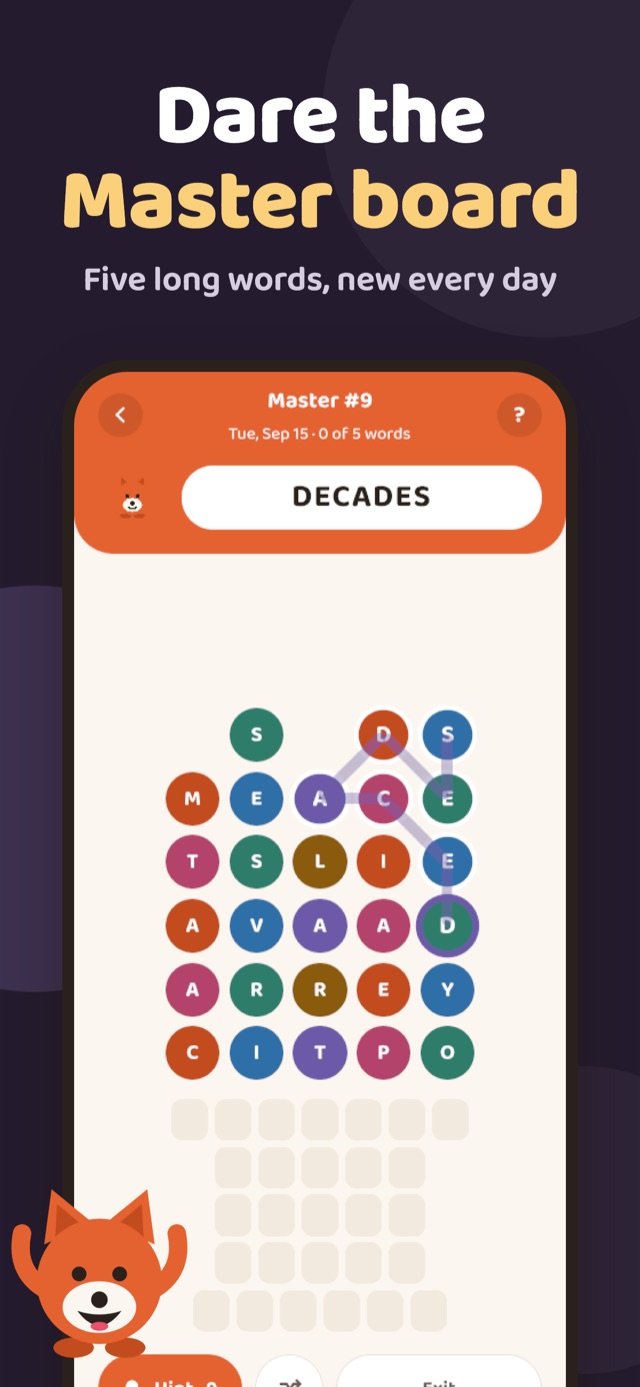
If a Sunday still is not enough, the same day carries a second board. The Master board asks for five words of five to seven letters and may reach up to 8,000 words down the list instead of 3,000 — so it draws on vocabulary the daily will never touch. It keeps its own statistics and never touches your streak, which is the point: it is extra, not a tax on the day.
How a phone builds a puzzle with no server
Here is the part that surprises people. Nothing is downloaded. The board is built on your phone, in the moment you open it, and it still comes out identical to everybody else’s.
The trick is that the generator is a pure function. Give it the day’s number, a fixed starting number baked into the app, the shape for that weekday and the word list for your language, and it produces one specific board. Give it the same four things tomorrow, or on a different phone, or in two years, and it produces exactly the same board again. There is no randomness in the everyday sense — there is a number that behaves unpredictably but never changes.
Three consequences follow, and they are the reason it is built this way:
- It works offline. The word list ships inside the app, so the daily board can be built in airplane mode or on the underground. A game that serves its daily from a server cannot do that. This is the practical difference between the two designs, and it is worth checking before you rely on one — how to test a game for airplane mode.
- Everyone gets the same board. Same day, same language, same puzzle, so a result is worth comparing even though nothing was fetched.
- The archive costs nothing. Any past day can be rebuilt from its number, so hundreds of boards take up no space and need no download. Inkwell Plus opens the whole archive.
One small piece of housekeeping sits underneath all this: the daily boards, the adventure levels and the event boards each use their own range of starting numbers, so that daily number twelve is never adventure level twelve wearing a different hat.
The other way to do it, honestly
Generating is not the only approach, and we use both. Wordfly’s daily Groups puzzle is not generated — it comes from a pack built into the app, 100 puzzles in every language, and once you reach the end it starts again.
That is the honest trade. A grouping puzzle depends on categories and wordplay that a generator cannot invent — someone has to think of them — so it is written by hand and shipped in a bundle. A word search can be generated because the difficulty lives in the layout and the vocabulary, both of which a machine handles well. Neither approach is better in the abstract; they suit different puzzles, and the thing worth knowing as a player is simply which one you are playing.
What it means at the board
- Don’t read Monday as your skill level. If Monday feels trivial and Saturday feels hard, that is the design working, not your form changing.
- Weekend words are longer, not weirder. The cap only moves from 1,500 to 3,000 — still firmly inside everyday vocabulary. You are being asked to see more, not to know more.
- Use the Master board as the real test. That is where the vocabulary widens, and it costs your streak nothing.
- A missed day is just a missed day. Because any board can be rebuilt, nothing is gone — the archive still has it.
Inkwell Word Puzzle
A new board every day, built on your phone, plus a Master board and 500 levels behind it. No clock, no score. Free on the App Store, no account, plays offline.

Frequently asked
Why are daily puzzles easier on Monday?
Because a daily puzzle has to survive your worst day, not just your best one. If Monday were as hard as Sunday, the people who play for five minutes before work would lose the habit in a fortnight. Crosswords have run this curve for decades, and most daily word games now do the same. In Inkwell, Monday asks for three words of four or five letters drawn from the 1,500 most common words in your language; Sunday asks for five words of five to seven letters drawn from the top 3,000.
Does everyone get the same daily puzzle?
Everyone playing the same day in the same language does, yes. The board is not downloaded — it is generated on your phone from the day's number and a fixed starting number, and the same inputs always produce the same board. That is why you can compare a result with a friend even though nothing was fetched from a server.
How can a daily puzzle work offline?
Only if the game can build the puzzle rather than fetch it. Inkwell ships the word list inside the app and generates each board on the device, so the daily works in airplane mode and on the underground. A game that serves its daily from a server cannot do that, which is the practical difference between the two designs.
What is the Master board?
A second, harder board for the same day: five words of five to seven letters, drawn from up to the 8,000 most common words rather than the 3,000 a Sunday uses. It keeps its own statistics, so it never touches your daily streak. It exists for the players who finish the daily and want more.
Why does the archive not need a download?
Because the board for any past day is a function of that day's number: feed the number in and the same board comes out. Nothing has to be stored or fetched, which is why an archive of hundreds of boards costs no space at all. Inkwell Plus opens the whole archive.
More reading: a map of the daily word games · why the language changes the difficulty · how a word search works.