Pocket Ninja Journal
Why a Word Game Is Not the Same Game in Every Language
· 7 min read
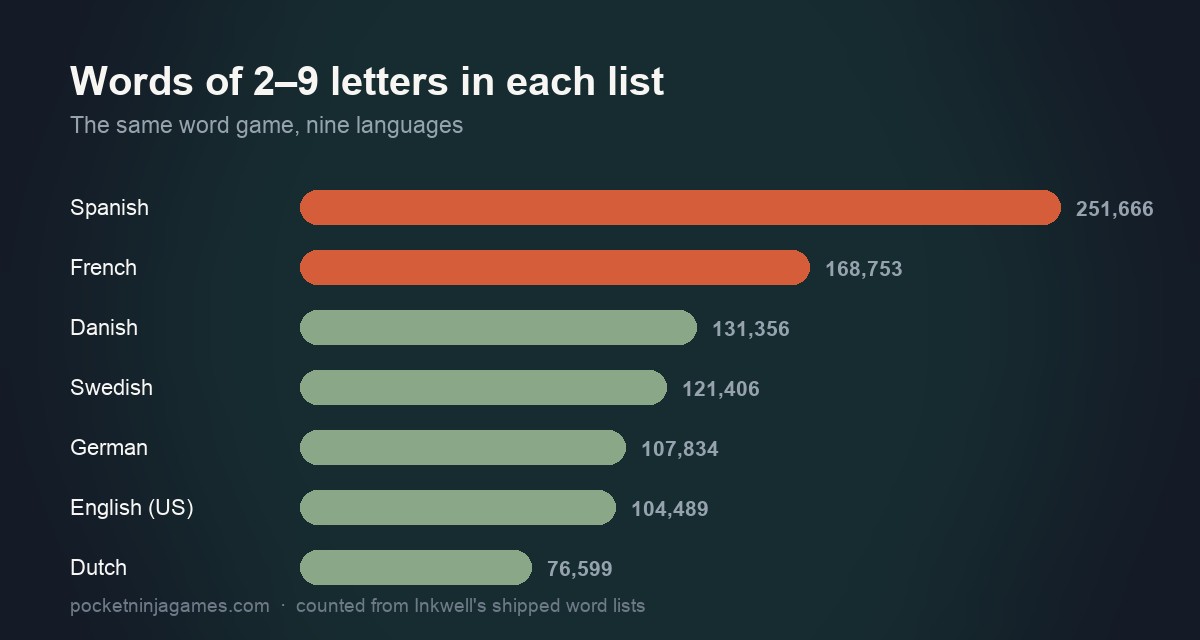
Short answer: the rules travel between languages, the difficulty does not. We ship nine word lists, one per language, and counting them shows two completely different ways a language can be rich: German, Swedish and Danish hide their words in long compounds, while Spanish and French bury theirs in verb endings.
Nine lists, not one translated list
Both our games play in nine languages, and each one has its own word list built from that language's own sources. Nothing is translated from English — a translated list would be a list of English ideas spelled in another language, which is not what a player of that language would look for. The list ships inside the app, which is also why the puzzles work without a connection.
That means we have nine measurements of the same thing sitting on disk, and they disagree in ways that turn out to explain how the game feels.
The count
Here is how many words of two to nine letters each list holds, and the average length of those words. These are Inkwell's lists, counted in September 2026:
| Language | Words of 2–9 letters | Average length |
|---|---|---|
| Spanish | 251,666 | 7.9 |
| French | 168,753 | 7.8 |
| Danish | 131,356 | 7.6 |
| Swedish | 121,406 | 7.5 |
| German | 107,834 | 7.8 |
| English (US) | 104,489 | 7.3 |
| Dutch | 76,599 | 7.4 |
Spanish holds nearly two and a half times as many short and medium words as American English. That is not a claim that Spanish is a bigger language. It is a claim about what counts as a separate word, and the two languages answer that question very differently.
Spanish and French: the words are the endings
Spanish conjugates a verb for person, tense and mood, and every one of those forms is a real word you could legitimately find on a board. Our Spanish list holds 72 forms built on the stem of hablar, to speak — hablo, hablas, habla, hablamos, hablaban, hablado, hablaría and on through the subjunctive. French does the same: 110 forms on the stem of parler.
English has 14 entries beginning with speak, and most of those are not forms of the verb at all — speaker, speakership, speakeasy. The verb itself manages about six.
At the board this changes what you are looking for. In Spanish, finding the stem is most of the work, because once you have seen habl the ending usually follows from the letters left over. The skill is pattern recognition on the first four letters rather than on the whole word.
German, Swedish, Danish and Dutch: the words are glued together
The Germanic languages other than English build new nouns by sticking old ones together, and the result is a single word. Swedish sommar plus stuga is sommarstuga, a summer cottage, and all three are in the list as separate words. The pattern is productive rather than a fixed vocabulary: our Swedish list holds 91 words ending in -huset and 66 ending in -bilen.
You can see the consequence in where each list keeps its bulk. This is the share of each list made up of words of ten letters or more:
| Language | Words of 10+ letters |
|---|---|
| German | 65% |
| Danish | 56% |
| Swedish | 51% |
| Dutch | 47% |
| English (US) | 31% |
Two thirds of the German list is long words. A third of the English one is. So a German board genuinely contains more findable answers than an English board of the same size — they are just harder to see, because a twelve-letter word has to be traced across most of the grid before you know you were right.
What this means if you play in more than one language
- English rewards knowing short words. With the smallest pool of the group, the difference between a good and an average player is the words you can always play — which is why the three-letter list is worth more in English than anywhere else.
- Swedish, German, Danish and Dutch reward reading long. Train your eye to keep going past the point where a word could have ended. The word that scores is usually the one you nearly stopped tracing.
- Spanish and French reward the stem. Find the first four or five letters, then let the remaining letters tell you which ending is available.
- A second language is not a handicap for long. Puzzle vocabulary is small and repeats, so a learner meets the same few thousand common words over and over — which is a decent argument for switching the language in Settings if you are studying one.
A note on how we counted
The first table stops at nine letters on purpose. The lists were built to fill puzzle boards rather than to be dictionaries, so they are capped at a maximum word length, and not every language is capped at the same place. Comparing full totals would partly measure our own cap rather than the language, so the comparable range — two to nine letters, which every list covers completely — is the honest one. The second table, on long words, only compares languages whose lists run to the same length.
The numbers come from Inkwell's lists. Wordfly ships the same nine languages and filters them slightly differently, so its totals are not identical. And these are word lists, not a census of the language: every one of them omits words a speaker would accept, which is true of every word game ever made.
Inkwell Word Puzzle
A calm word search in nine languages, each with its own word list. Switch language in Settings and the boards change with it. Free on the App Store, no account, plays offline.

Frequently asked
Which language is hardest for word games?
There is no honest single answer, because the languages are hard in different places. A compounding language like German or Swedish has far more long words, so a board holds more possible answers but each one is harder to see. An inflected language like Spanish or French has a dense mass of medium-length words that differ by an ending, so spotting the stem matters more than spotting the whole word. English has the fewest words of either kind, which makes each individual find worth more.
Why does German have so many long words?
Because German glues nouns together to make new ones, and each combination is a word in its own right. In Inkwell's German list 65 per cent of the words are ten letters or longer, against 31 per cent in the American English list. Swedish, Danish and Dutch do the same thing, which is why they sit in the same part of the table.
Why does Spanish have the most words?
Verb endings. Spanish conjugates for person, tense and mood, and every form counts as a playable word. Our Spanish list holds 72 forms built on the stem of hablar, to speak. The English list has 14 entries beginning with speak, and most of those are nouns like speaker rather than forms of the verb. French is the same: 110 forms on the stem of parler.
Do the games use different dictionaries per language?
Yes. Each of the nine languages has its own list, built from that language's own sources rather than translated from English, and the list ships inside the app so the puzzles work offline. English comes in three editions — American, British and Australian — because the three disagree about enough words to matter.
Does the language change how a puzzle is built?
It changes what can appear on the board, because a board is filled from the list for the language you are playing in. It does not change the rules. A word search is a word search in all nine.
More reading: how a word search works · every type of word game explained · the three-letter words worth knowing.